Be yourself; Everyone else is already taken.
— Oscar Wilde.
This is the first post on my new blog. I’m just getting this new blog going, so stay tuned for more. Subscribe below to get notified when I post new updates.
Be yourself; Everyone else is already taken.
— Oscar Wilde.
This is the first post on my new blog. I’m just getting this new blog going, so stay tuned for more. Subscribe below to get notified when I post new updates.
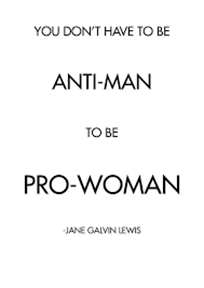
Feminists are not unattractive, angry lesbians who hate men. Feminists do not believe women are better than men, or that women are victims who deserve special privileges. Feminists are not pro-choice career women who do not support stay-at-home mums. Feminism, by definition, is the advocacy of women’s rights on the ground of the equality of the sexes.
To be a feminist, you only need to believe in the single idea that all humans, male and female should have equal economic, political and social rights.
Although the feminist movement has made a huge impact and expanded, it has always had a negative stigma (a mark of disgrace) attached to it which has increased lately due to the rising influence of the media. It often sensationalises feminists by portraying them in their most radical form which causes people who aren’t educated on feminism, to depict them as man-haters who unapologetically favour abortions. This leads to the formation of stereotypes – a widely held, fixed and oversimplified view of a particular person/thing. However, a person who hates men is known as a ‘misandrist’ not a ‘feminist’.
Another cause of prejudice against feminists can be explained by the social identity theory proposed by Tajfel and Turner (1979) which explains grouping through the stages of ‘categorisation’ and ‘identification.’ They believe that an individual’s self-concept (an idea of the self, constructed from the beliefs held about oneself and responses of others) is reliant on the group they are in, known as the in-group which may be joined due to the interests and appearance. The attitudes and behaviours of the group are then adopted in order to identify with and belong to the group. Those who are not in the in-group are referred to as the out-group and are discriminated against based on the stereotypes. Moreover, the out-group is viewed negatively so the in-group is perceived as ‘better’ which increases their self-esteem. In this case, anti-feminists define their self-concept and identity by categorising themselves into a group based on its characteristics. For instance, they may join the ‘Men’s rights movement’ due to its focus on discrimination against men. They then identify with them by sharing the same attitudes and behaviours – attempting to protect men from false rape accusations. Self-esteem is affected by group membership, so members are motivated to improve the image and status of the group, perhaps by increasing efforts in raising awareness of the issues to attract more followers.
I myself, have witnessed hate comments being made against feminists on social media and these are often from ‘Men’s rights activists.’ They use terms such as “rabid feminists,” “crazy feminists” and “feminist bullies.” The founder of the ‘Voice for Men’ movement referred to feminism as “cancer” in one of his comments (Archer, 2018).
On Twitter, @AlanEngland4 said: “Many so-called feminist gatherings are not pretty either; it’s the three-day stubble which gets me!”
Aside from online abuse, the stereotypes against feminists are apparent in everyday life. On numerous occasions, I have found that upon informing people that I identify as a feminist, I would receive the typical disappointed response of “Oh so you hate men,” or “Are you into women then?” (particularly from men) which highlights the misconception surrounding what it is to be a feminist.
This wrongful stereotypical image of feminists has led to women, particularly millennials, to dissociate themselves from the term feminist. A survey by CBS News regarding socio-political views, found that an astounding 54% of US women do not identify themselves as advocates of the movement for gender equality as opposed to 46% who did (Petter, 2018).
There have also been anti-feminist campaigns such as ‘Women against Feminism’ where members post statements such as “I don’t need feminism because I don’t ignore the fact that men have issues too” (Cavanagh, 2017).
Although feminism may not be your personal want or need, equal treatment is what we need as humans, it is what we need as a society.
It is incorrectly assumed that feminists are not aware that men also suffer from gender role expectations and are unfairly expected to act a certain way. Feminists believe people should not be observed by the strengths that are assumed of their gender, but on their individual aptitudes and strengths as humans.
Furthermore, anti-feminists believe feminism is now irrelevant as we have gained voting rights and the system is not patriarchal – this idea encourages more unfavourable stereotypes against feminists.
Contrary to popular belief, we still need feminism to continue making changes until every woman feels equal.
We still need feminism because:
1 in 3 women are sexually abused at some point in their lifetime, with such high statistics it is imperative that circumstances improve.
When couples marry, it is expected that the woman will take the man’s last name.
When assaulted, women are the victims, yet they feel ashamed.
When discussing the prevention of rape, women are advised on how to dress and act rather than men being taught not to objectify women.
Women are discouraged to walk alone at night as this makes them “easy targets.”
Terms such as “pussy” and “bitch” are still used as insults to show weakness.
In over 120 countries, no laws against marital rape have been made and child brides are permitted (Cavanagh, 2017).
In Afghanistan, a woman attending college is considered reasonable grounds for disfigurement. (Cavanagh, 2017).
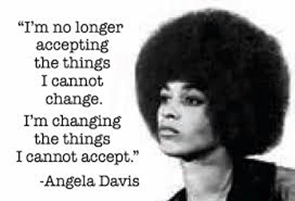
So, what does it really mean to be a feminist? Not that you believe women do not have their own voice, but you are aware that even though many now have the privilege to speak out, there are still many who cannot. It is important to remember that the privileges we are granted stem from centuries of oppression. We can use this privilege to resolve the serious inequalities for a more equitable society instead of wasting time mistakenly labelling feminists as what they are not. There is no criteria needed to fit the image of a feminist as it is not about telling women how they should look and what they need, it is about freedom and choice (whether that is used to be a professional housewife or a business CEO) not being limited due to stereotypical assumptions.
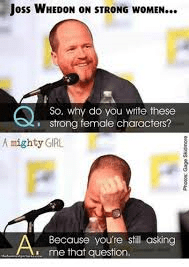
Why do we need feminism? For the same reason John Whedon gave, “Because you’re still asking me that question.”
References:
Archer, N. (2018). ‘Feminism is cancer’: the angry backlash against our reporting on the men’s rights movement. Retrieved from https://www.opendemocracy.net/en/5050/feminism-is-cancer-mens-rights-activists-online-backlash/
Cavanagh, C. (2017). Why we still need Feminism. Retrieved from https://www.huffpost.com/entry/why-we-still-need-feminism_b_5837366?guccounter=1&guce_referrer=aHR0cHM6Ly93d3cuZ29vZ2xlLmNvbS8&guce_referrer_sig=AQAAAGGHj-weoPXgUfm-vXUkWZBoARJAelw26BKCr4HEEryAhO_rTXTi1YwL9aTdiqNxLdrGYCo2R1JVaMWnlLyHZhzNYp4YF6nHXmO8GrIb38j_R3jz8D6rK9USnkdSGRYgI7hSlV56nj8xqke-D1DK9azN-BmQdy5WhuNyssOdcrfE
Petter, O. (2018). More than half of millennial women don’t identify as Feminist, poll finds. Retrieved from https://www.independent.co.uk/life-style/women/millennials-feminist-dont-identity-poll-refinery29-activism-a8492271.html
Tajfel, H., Turner, J. C., Austin, W. G., & Worchel, S. (1979). An integrative theory of intergroup conflict. Organizational identity: A reader, 56-65.
This is an example post, originally published as part of Blogging University. Enroll in one of our ten programs, and start your blog right.
You’re going to publish a post today. Don’t worry about how your blog looks. Don’t worry if you haven’t given it a name yet, or you’re feeling overwhelmed. Just click the “New Post” button, and tell us why you’re here.
Why do this?
The post can be short or long, a personal intro to your life or a bloggy mission statement, a manifesto for the future or a simple outline of your the types of things you hope to publish.
To help you get started, here are a few questions:
You’re not locked into any of this; one of the wonderful things about blogs is how they constantly evolve as we learn, grow, and interact with one another — but it’s good to know where and why you started, and articulating your goals may just give you a few other post ideas.
Can’t think how to get started? Just write the first thing that pops into your head. Anne Lamott, author of a book on writing we love, says that you need to give yourself permission to write a “crappy first draft”. Anne makes a great point — just start writing, and worry about editing it later.
When you’re ready to publish, give your post three to five tags that describe your blog’s focus — writing, photography, fiction, parenting, food, cars, movies, sports, whatever. These tags will help others who care about your topics find you in the Reader. Make sure one of the tags is “zerotohero,” so other new bloggers can find you, too.

 Zahra's blog